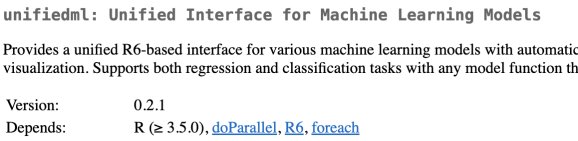
O nouă versiune a unifiedml este afară; disponibil pe CRAN. unifiedml este un efort de a oferi o interfață unificată modelelor de învățare automată ale lui R.
Principala schimbare în această versiune 0.2.1 este eliminarea type (de predicție) din predictși utilizarea de... în schimb, care este mai generic și mai flexibil.
Această postare conține exemple avansate de utilizare a unifiedml pentru clasificarecu ranger şi xgboost. Mai multe exemple au fost adăugate și la vignetele pachetului.
install.packages("unifiedml")

install.packages(c("ranger"))

library("unifiedml")

Loading required package: doParallel

Loading required package: foreach

Loading required package: iterators

Loading required package: parallel

Loading required package: R6
library(ranger)


# 2 - 'ranger' classification ---------------------------

# -------------------------------
# S3 wrapper for ranger
# -------------------------------

# Fit function remains the same
my_ranger <- function(x, y, ...) {
  if (!is.data.frame(x)) x <- as.data.frame(x)
  y <- as.factor(y)
  colnames(x) <- paste0("X", seq_len(ncol(x)))
  df <- data.frame(y = y, x)
  fit <- ranger::ranger(y ~ ., data = df, probability = TRUE, ...)
  structure(list(fit = fit), class = "my_ranger")
}

# Predict only with newdata
predict.my_ranger <- function(object, newdata = NULL, newx = NULL, ...) {
  if (!is.null(newx)) newdata <- newx
  if (is.null(newdata)) stop("No data provided for prediction")
#  misc::debug_print(newx)
#  misc::debug_print(newdata)
  if (is.matrix(newdata)) newdata <- as.data.frame(newdata)
#  misc::debug_print(newdata)
  # Unconditionally rename to match training
  colnames(newdata) <- paste0("X", seq_len(ncol(newdata)))
#  misc::debug_print(newdata)
  preds <- predict(object$fit, data = newdata)$predictions
#  misc::debug_print(newdata)
  if (is.matrix(preds) && ncol(preds) == 2) {
    lvls <- colnames(preds)
    return(ifelse(preds(, 2) > 0.5, lvls(2), lvls(1)))
  }

  preds
}

# Print method
print.my_ranger <- function(x, ...) {
  cat("my_ranger modeln")
  print(x$fit)
}

# -------------------------------
# Example: Iris binary classification
# -------------------------------

set.seed(123)
iris_binary <- iris(iris$Species %in% c("setosa", "versicolor"), )
X_binary <- iris_binary(, 1:4)
y_binary <- as.factor(as.character(iris_binary$Species))

# Train/test split
train_idx <- sample(seq_len(nrow(X_binary)), size = 0.7 * nrow(X_binary))
X_train <- X_binary(train_idx, )
y_train <- y_binary(train_idx)
X_test <- X_binary(-train_idx, )
y_test <- y_binary(-train_idx)

# Initialize and fit model
# Initialize model
mod <- Model$new(my_ranger)

# Fit on training data only
mod$fit(X_train, y_train, num.trees = 150L)

# Predict on test set
preds <- mod$predict(X_test)

# Evaluate
table(Predicted = preds, True =y_test)
mean(preds == y_test)  # Accuracy


# 5-fold cross-validation on training set
cv_scores <- cross_val_score(
  mod,
  X_train,
  y_train,
  num.trees = 150L,
  cv = 5L
)

cv_scores
mean(cv_scores)  # average CV accuracy


            True
Predicted    setosa versicolor
  setosa         15          0
  versicolor      0         15
1
|======================================================================| 100%
- 1
- 1
- 1
- 1
- 1
1
library(xgboost)

my_xgboost <- function(x, y, ...) {

  # Convert to matrix safely
  if (!is.matrix(x)) {
    x <- as.matrix(x)
  }

  # Handle factors
  if (is.factor(y)) {
    y <- as.numeric(y) - 1
  }

  fit <- xgboost::xgboost(
    data = x,
    label = y,
    ...
  )

  structure(list(fit = fit), class = "my_xgboost")
}

predict.my_xgboost <- function(object, newdata, ...) {

  # Ensure matrix
  newdata <- as.matrix(newdata)

  preds <- predict(object$fit, newdata)

  # If binary classification → convert probs to class
  if (!is.null(object$fit$params$objective) &&
      grepl("binary", object$fit$params$objective)) {

    return(ifelse(preds > 0.5, 1, 0))
  }

  preds
}

predict.my_xgboost <- function(object, newdata = NULL, newx = NULL, ...) {

  # Accept both conventions
  if (!is.null(newx)) {
    newdata <- newx
  }

  newdata <- as.matrix(newdata)

  preds <- predict(object$fit, newdata)

  # Binary classification → class labels
  if (!is.null(object$fit$params$objective) &&
      grepl("binary", object$fit$params$objective)) {

    return(ifelse(preds > 0.5, 1, 0))
  }

  preds
}

print.my_xgboost <- function(x, ...) {
  cat("my_xgboost modeln")
  print(x$fit)
}


set.seed(123)  # for reproducibility

# Binary subset
iris_binary <- iris(iris$Species %in% c("setosa", "versicolor"), )
X_binary <- as.matrix(iris_binary(, 1:4))
y_binary <- as.factor(as.character(iris_binary$Species))

# Split indices: 70% train, 30% test
train_idx <- sample(seq_len(nrow(X_binary)), size = 0.7 * nrow(X_binary))
X_train <- X_binary(train_idx, )
y_train <- y_binary(train_idx)
X_test <- X_binary(-train_idx, )
y_test <- y_binary(-train_idx)

# Initialize model
mod <- Model$new(my_xgboost)

# Fit on training data only
mod$fit(X_train, y_train, nrounds = 50, objective = "binary:logistic")

# Predict on test set
preds <- mod$predict(X_test)

# Evaluate
table(Predicted = preds, True =y_test)
mean(preds == y_test)  # Accuracy


# 5-fold cross-validation on training set
cv_scores <- cross_val_score(
  mod,
  X_train,
  y_train,
  nrounds = 50,
  objective = "binary:logistic",
  cv = 5L
)

cv_scores
mean(cv_scores)  # average CV accuracy