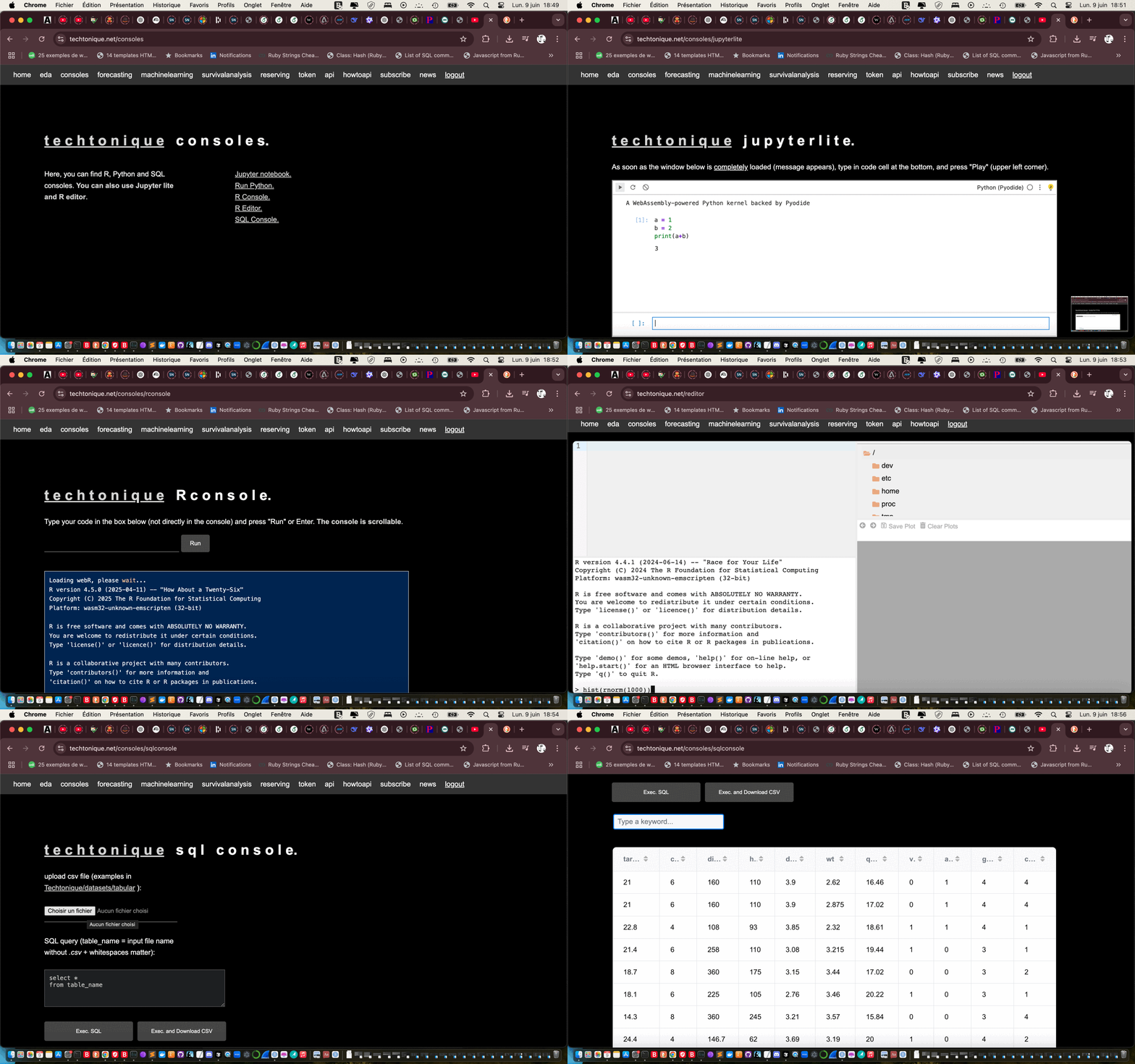
https://www.techtonique.net conține instrumente pentru Analiza exploratorie a datelor (EDA), editori pentru codul R și Python, instrumente pentru vizualizarea datelor, interfețe web fără cod pentru diverse sarcini de știință a datelor, un API independent de limbă pentru sarcini de învățare automată (clasificare, regresie, analiză de supraviețuire, rezervare, prognoză etc.).
Am observat recent o ţeapă în înscrieri (nu sunt sigur cum au observat că a fost din nou, fără anunț oficial…), și am crezut că este o ocazie bună să împărtășesc asta techtonique.net a revenit. Mai degrabă un proiect pasional sau parte dintr-un portofoliu (deocamdată). API-ul este disponibil și evoluează. Îl puteți folosi gratuit (cu limitare a ratei), dar vă rugăm să rețineți că este puțin mai lent decât înainte (într-adevăr, obișnuiam să aveam Azure Credits datorită Microsoft for Startups => un server mai rapid). Mai servește răspunsurile, într-un timp rezonabil totuși, și voi încerca să-l optimizez pe cât posibil.
Merită menționat că am eliminat API-ul de simulare stocastică deocamdată, deoarece necesita (mai tehnic) rularea R în Python, printr-un container Docker.
Iată câteva exemple despre cum să utilizați API-ul pentru sarcini de învățare automată în R și Python (există, de asemenea, interfețe fără cod pentru aceste sarcini pe site-ul web, iar API-ul este independent de limbaj, așa că îl puteți utiliza cu orice limbaj de programare care poate face solicitări HTTP):
Punctul de plecare este înregistrarea/conectarea (dacă întâmpinați probleme, contactați (protejat prin e-mail)) și obțineți un token de la: https://www.techtonique.net/token. Apoi, puteți utiliza simbolul în solicitările API pentru sarcini de învățare automată. Fiecare răspuns este o predicție, așa cum este prevăzut de modelul ales și bazată pe datele de intrare.
#!/usr/bin/env Rscript

# Install httr if needed: install.packages("httr")
# All you need is a token from www.techtonique.net/token, then run the script
library(httr)

BASE_URL   <- "https://www.techtonique.net"
GITHUB_RAW <- "https://raw.githubusercontent.com/Techtonique/datasets/main"

DATASETS <- list(
  univariate     = paste0(GITHUB_RAW, "/time_series/univariate/a10.csv"),
  multivariate   = paste0(GITHUB_RAW, "/time_series/multivariate/ice_cream_vs_heater.csv"),
  classification = paste0(GITHUB_RAW, "/tabular/classification/breast_cancer_dataset2.csv"),
  regression     = paste0(GITHUB_RAW, "/tabular/regression/boston_dataset2.csv"),
  raa            = paste0(GITHUB_RAW, "/tabular/triangle/raa.csv"),
  abc            = paste0(GITHUB_RAW, "/tabular/triangle/abc.csv"),
  km             = paste0(GITHUB_RAW, "/tabular/survival/kidney.csv"),
  ridge_survival = paste0(GITHUB_RAW, "/tabular/survival/gbsg2_2.csv")
)

# ---------------------------------------------------------------------------
# Helpers
# ---------------------------------------------------------------------------

get_token <- function() {
  args <- commandArgs(trailingOnly = TRUE)
  idx  <- which(args == "--token")
  if (length(idx) > 0 && idx < length(args)) return(args(idx + 1))
  cat("Please enter your JWT token: ")
  readLines(con = "stdin", n = 1)
}

# Download a GitHub dataset to a temp file and return its path.
# Using a real file is the only reliable way to do multipart uploads in httr.
fetch_dataset <- function(key) {
  url      <- DATASETS((key))
  filename <- basename(url)
  cat(sprintf("  Fetching %s from GitHub... ", filename))
  tmp <- tempfile(fileext = ".csv")
  resp <- GET(url, write_disk(tmp, overwrite = TRUE))
  stop_for_status(resp)
  cat("OKn")
  tmp   # return the temp file path
}

make_request <- function(endpoint, token, dataset_key = NULL, params = list()) {
  url     <- paste0(BASE_URL, endpoint)
  headers <- add_headers(Authorization = paste("Bearer", token))

  if (!is.null(dataset_key)) {
    tmp_path <- fetch_dataset(dataset_key)
    on.exit(unlink(tmp_path), add = TRUE)   # clean up temp file when done
    body <- list(file = upload_file(tmp_path, type = "text/csv"))
    resp <- POST(url, headers, query = params, body = body, encode = "multipart")
  } else {
    resp <- GET(url, headers, query = params)
  }

  if (http_error(resp)) {
    cat(sprintf("  ERROR %s: %sn", status_code(resp),
                content(resp, as = "text", encoding = "UTF-8")))
    return(NULL)
  }
  content(resp, as = "parsed", type = "application/json")
}

print_response <- function(resp) {
  if (is.null(resp)) return(invisible(NULL))
  for (key in names(resp)) {
    val <- resp((key))
    if (is.list(val) || length(val) > 6) {
      cat(sprintf("  %s: (%s ...)n", key, paste(head(unlist(val), 6), collapse = ", ")))
    } else {
      cat(sprintf("  %s: %sn", key, paste(val, collapse = ", ")))
    }
  }
}

# ---------------------------------------------------------------------------
# Test sections
# ---------------------------------------------------------------------------

test_forecasting <- function(token) {
  cat("n=== Testing Forecasting Endpoints ===n")

  cat("nTesting univariate forecasting...n")
  resp <- make_request("/forecasting", token,
    dataset_key = "univariate",
    params = list(base_model = "RidgeCV", n_hidden_features = 5,
                  lags = 25, type_pi = "kde", replications = 4, h = 3))
  print_response(resp)

  cat("nTesting multivariate forecasting...n")
  resp <- make_request("/forecasting", token,
    dataset_key = "multivariate",
    params = list(base_model = "RidgeCV", n_hidden_features = 5, lags = 25, h = 3))
  print_response(resp)
}

test_ml <- function(token) {
  cat("n=== Testing Machine Learning Endpoints ===n")

  cat("nTesting classification...n")
  resp <- make_request("/mlclassification", token,
    dataset_key = "classification",
    params = list(base_model = "RandomForestClassifier",
                  n_hidden_features = 5, predict_proba = TRUE))
  print_response(resp)

  cat("nTesting regression...n")
  resp <- make_request("/mlregression", token,
    dataset_key = "regression",
    params = list(base_model = "RidgeCV", n_hidden_features = 5, return_pi = TRUE))
  print_response(resp)
}

test_reserving <- function(token) {
  cat("n=== Testing Reserving Endpoints ===n")

  cat("nTesting RidgeCV...n")
  resp <- make_request("/mlreserving", token,
    dataset_key = "raa",
    params = list(method = "RidgeCV"))
  print_response(resp)

  cat("nTesting LassoCV...n")
  resp <- make_request("/mlreserving", token,
    dataset_key = "abc",
    params = list(method = "LassoCV"))
  print_response(resp)
}

test_survival <- function(token) {
  cat("n=== Testing Survival Analysis Endpoints ===n")

  cat("nTesting Kaplan-Meier...n")
  resp <- make_request("/survivalcurve", token,
    dataset_key = "km",
    params = list(method = "km"))
  print_response(resp)

  cat("nTesting Ridge survival...n")
  resp <- make_request("/survivalcurve", token,
    dataset_key = "ridge_survival",
    params = list(method = "RidgeCV", patient_id = 0))
  print_response(resp)
}

# ---------------------------------------------------------------------------
# Main
# ---------------------------------------------------------------------------

main <- function() {
  token <- get_token()
  test_forecasting(token)
  test_ml(token)
  test_reserving(token)
  test_survival(token)
}

main()
import argparse
import requests
import os
import io
from typing import Dict, Any

# All you need is a token from www.techtonique.net/token, then run the script

# Base URL for API endpoints
base_url = "https://www.techtonique.net"

# Base URL for raw GitHub content
GITHUB_RAW = "https://raw.githubusercontent.com/Techtonique/datasets/main"

# Dataset paths within the GitHub repo
DATASETS = {
    "univariate":       f"{GITHUB_RAW}/time_series/univariate/a10.csv",
    "multivariate":     f"{GITHUB_RAW}/time_series/multivariate/ice_cream_vs_heater.csv",
    "classification":   f"{GITHUB_RAW}/tabular/classification/breast_cancer_dataset2.csv",
    "regression":       f"{GITHUB_RAW}/tabular/regression/boston_dataset2.csv",
    "raa":              f"{GITHUB_RAW}/tabular/triangle/raa.csv",
    "abc":              f"{GITHUB_RAW}/tabular/triangle/abc.csv",
    "km":               f"{GITHUB_RAW}/tabular/survival/kidney.csv",
    "ridge_survival":   f"{GITHUB_RAW}/tabular/survival/gbsg2_2.csv",
}


def get_token() -> str:
    """Get token from command line argument or prompt"""
    parser = argparse.ArgumentParser(description='Test API endpoints')
    parser.add_argument('--token', help='JWT token for authentication')
    args = parser.parse_args()

    if args.token:
        return args.token

    return input("Please enter your JWT token: ")


def fetch_dataset(dataset_key: str) -> tuple(io.BytesIO, str):
    """
    Download a dataset from GitHub and return it as an in-memory bytes buffer
    together with a filename, ready to be passed to requests as a file upload.
    """
    url = DATASETS(dataset_key)
    filename = url.split("/")(-1)
    print(f"  Fetching {filename} from GitHub...", end=" ")
    response = requests.get(url)
    response.raise_for_status()
    print("OK")
    return io.BytesIO(response.content), filename


def make_request(
    url: str,
    token: str,
    method: str = "POST",
    file_tuple: tuple = None,   # (BytesIO, filename)
    params: Dict = None,
) -> Dict(str, Any):
    """Make an API request and return the response."""
    headers = {"Authorization": f"Bearer {token}"}

    try:
        if method == "POST":
            files = None
            if file_tuple:
                buf, filename = file_tuple
                files = {"file": (filename, buf, "text/csv")}
            response = requests.post(url, headers=headers, files=files, params=params)
        else:
            response = requests.get(url, headers=headers, params=params)

        response.raise_for_status()
        return response.json()

    except requests.exceptions.RequestException as e:
        print(f"Error making request to {url}:")
        print(f"Status code: {e.response.status_code if hasattr(e, 'response') else 'N/A'}")
        print(f"Response: {e.response.text if hasattr(e, 'response') else str(e)}")
        return None


def test_forecasting(token: str):
    print("n=== Testing Forecasting Endpoints ===")

    print("nTesting univariate forecasting...")
    response = make_request(
        f"{base_url}/forecasting", token,
        file_tuple=fetch_dataset("univariate"),
        params={"base_model": "RidgeCV", "n_hidden_features": 5,
                "lags": 25, "type_pi": "kde", "replications": 4, "h": 3},
    )
    if response:
        print("Response:", response)

    print("nTesting multivariate forecasting...")
    response = make_request(
        f"{base_url}/forecasting", token,
        file_tuple=fetch_dataset("multivariate"),
        params={"base_model": "RidgeCV", "n_hidden_features": 5, "lags": 25, "h": 3},
    )
    if response:
        print("Response:", response)


def test_ml(token: str):
    print("n=== Testing Machine Learning Endpoints ===")

    print("nTesting classification...")
    response = make_request(
        f"{base_url}/mlclassification", token,
        file_tuple=fetch_dataset("classification"),
        params={"base_model": "RandomForestClassifier",
                "n_hidden_features": 5, "predict_proba": True},
    )
    if response:
        print("Response:", response)

    print("nTesting regression...")
    response = make_request(
        f"{base_url}/mlregression", token,
        file_tuple=fetch_dataset("regression"),
        params={"base_model": "RidgeCV", "n_hidden_features": 5, "return_pi": True},
    )
    if response:
        print("Response:", response)


def test_reserving(token: str):
    print("n=== Testing Reserving Endpoints ===")

    print("nTesting RidgeCV...")
    response = make_request(
        f"{base_url}/mlreserving", token,
        file_tuple=fetch_dataset("raa"),
        params={"method": "RidgeCV"},
    )
    if response:
        print("Response:", response)

    print("nTesting LassoCV...")
    response = make_request(
        f"{base_url}/mlreserving", token,
        file_tuple=fetch_dataset("abc"),
        params={"method": "LassoCV"},
    )
    if response:
        print("Response:", response)


def test_survival(token: str):
    print("n=== Testing Survival Analysis Endpoints ===")

    print("nTesting Kaplan-Meier...")
    response = make_request(
        f"{base_url}/survivalcurve", token,
        file_tuple=fetch_dataset("km"),
        params={"method": "km"},
    )
    if response:
        print("Response:", response)

    print("nTesting Ridge survival...")
    response = make_request(
        f"{base_url}/survivalcurve", token,
        file_tuple=fetch_dataset("ridge_survival"),
        params={"method": "RidgeCV", "patient_id": 0},
    )
    if response:
        print("Response:", response)


def main():
    token = get_token()
    test_forecasting(token)
    test_ml(token)
    test_reserving(token)
    test_survival(token)


if __name__ == "__main__":
    main()